Articles & case studies

Migrating 22 Legacy Systems for an $11.3B Beauty Product Manufacturer
Project Summary
After years of acquiring various brands and companies, a $11.3B global leader in the beauty industry was left supporting and maintaining dozens of different HR/payroll systems.
These systems were administered by the individual lines of business as well as outsourced third party administrators (TPAs). To increase productivity, and leverage resources across their entire enterprise, the organization initiated a multi-year Global HR Transformation project. This study represents the largest phase of the implementation, which encompassed the consolidation of the organization’s 22 EMEA business units and brands into a single instance of Oracle HCM.
“Fantastic job! A huge amount of effort, very much appreciated. Thank you.”
– HR Transformation Deployment Lead [UK/EMEA]
Client Challenges
The size, scope, and schedule of this project combined for several unique client challenges, including:
- Many of the databases underlying the disparate legacy HR systems were outdated, unsupported and/or highly customized.
- Legacy systems had poor data quality, with high frequency of missing, inconsistent, and invalid data.
- With almost 22,000 employee records across 22 different legacy HR systems, data duplication was extremely high.
- The different legacy systems were run by various third party administrators, therefore the team had limited access to the backend data. Data extracts had to be scheduled with ample notice in the cases where data was permitted to be extracted.
- Data extract files provided by the business and TPAs proved to be highly inconsistent, both in structure and in content, from one iteration to the next.
- The data structures of the various legacy systems were drastically different from the target Oracle HCM data structure.
- Due to the high number of legacy systems and the tight cutover time frame, the schedule did not allow for the Oracle HCM load programs to identify issues that would cause a record to fail; data quality issues needed to be found and addressed early in the process to ensure no data was lost.
Requirements
The overall data migration requirements for this phase of the Global HR Transformation were:
- The team had six months to complete the project, therefore an ongoing, collaborative process between Definian and the client needed to be developed to facilitate data cleansing and error handling.
- The data from 22 distinct and separate HR/payroll systems needed to be extracted, consolidated, harmonized, cleansed, and transformed before it could be loaded into a single instance of Oracle HCM.
- The data migration process needed to handle duplicate employees both within and across disparate legacy systems to only convert the most recent (“Top of Stack”) employment history.
- The conversion needed to correctly transform and consolidate data from 22 different systems to a standardized Oracle data model for all key fields.
- The conversion required complex logic to assign supervisor IDs for all employees and accommodate various levels of data integrity and quality issues.
- Since the project was focused on migrating sensitive employee and payroll data in a tight timeframe, the prioritization of data security was imperative to the project’s success.
Key Activities
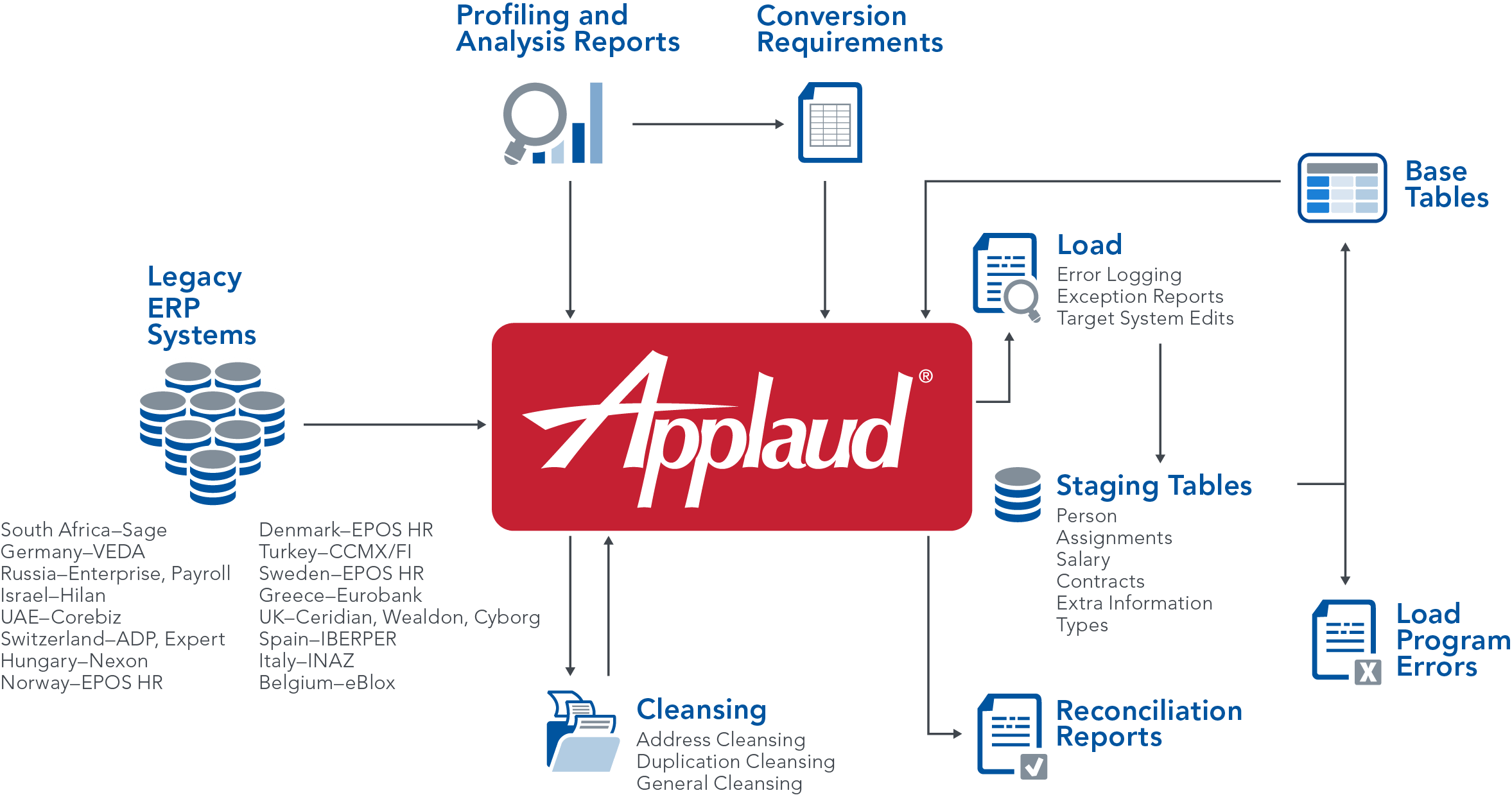
- The team began by using Applaud’s robust, automated analytic capabilities to identify and report the high volume of data inconsistency between the disparate legacy data extracts provided by the business and the TPAs.
- A deeper analysis of the legacy data was done using Applaud’s integrated analytics/reporting tools. This allowed the team to proactively identify legacy data issues.
- Valuable time in the schedule was saved when Applaud’s automated profiling process clarified the data landscape for every field/source and assisted with the create of data conversion requirements.
- Cleansing tools provided in the Applaud software assisted the team in standardizing, consolidating, correcting, and enriching data quality as issues were uncovered as opposed to waiting for load programs to identify quality gaps.
- Applaud’s powerful data matching engine applied “Top of Stack” logic to identify duplicate employee/dependent data within and across the various legacy systems so that only the most recent employment history was converted.
- Applaud’s data transformation capabilities were leveraged to create separate data migration and harmonization processes for each of the 22 legacy systems.
- Before loading to the target Oracle HCM tables, Applaud’s built-in reporting tools were utilized to quickly develop robust and thorough error handling—preemptively catching and allowing time to correct load errors.
- The combined profiling and data transformation error reporting allowed the teams to create an efficient, traceable data quality improvement process to enhance and enrich data prior to the final go-live cutover.
The Bottom Line
The Results

After only six months, the project team was able to successfully harmonize and migrate the data from 22 different legacy systems into a single Oracle HCM solution. The repeatable data cleansing processes resulted in error free data loads, culminating in a smooth and uneventful go live that boosted the confidence in the overall data quality.

Despite the volume of data extracts from TPAs and the scope of data quality issues between the 22 legacy systems, the project was completed on time and on budget.
Furthermore, the work performed up-front identified data quality baselines, which allowed business requirements to be developed based on facts instead of assumptions.
Data transformation processes harmonized the employee information between 22 different EMEA sources, ensuring that the “Top Stack” data was migrated in the Oracle HCM solution. Combined with the limited number of test cycles, the time and effort saved were invaluable to the project timeline.
The Applaud® Advantage
To help overcome the expected data migration challenges, the organization engaged Definian’s Applaud® data migration services to eliminate the risk from their data migration and ensure the overall success of their Global HR Transformation.
Three key components of Definian’s Applaud solution helped the client navigate their data migration:

- Definian’s data migration consultants: Definians services group averages more than six years of experience working with Applaud, exclusively on data migration projects.
- Definian’s methodology: Definian’s EPACTL approach to data migration projects is different than traditional ETL approaches and helps ensure the project stays on track. This methodology decreases overall implementation time and reduces the risk of the migration.
- Definian’s data migration software, Applaud: Applaud has been optimized to address the challenges that occur on data migration projects, allowing the team to accomplish all data needs using one integrated product.
The combined aspects of the Applaud solution were leveraged to meet the challenges of the Global HR Transformation project.

Data Migration Rescue for a $14B Surgical Equipment Company
Project Summary
A $14B Surgical Equipment Company was in the midst of consolidating a recent acquisition into their existing JD Edwards EnterpriseOne (E1) application. Prior to Definian joining the project, the majority of the data migration work was being performed by the client.
As the go live date approached, migration development had already fallen significantly behind target, to the point that proceeding on the projected track would have put the entire implementation at risk.
If an automated solution could not be developed and tested in the next 38 days, the client faced a painful contingency plan that required manual dual-maintenance across JDE E1 and the legacy system while waiting for thousands of transactions to bleed out. During this time, the entire team would have worked longer than usual hours to support multiple systems, inconsistencies introduced across the systems would lead to frustration and confusion with customers and suppliers, and the IT Department would continue paying for legacy software and hardware.
The client’s System Integrator (SI) brought in Definian to rescue the original timeline by building automated conversions for Sales Orders and Purchase Orders, thus allowing the legacy system, MFG/PRO, to be completely shut down immediately after go-live.
Requirements
- Document, develop, and build automated conversion processes that will extract Purchase Orders and Sales Orders from the legacy systems and load them to JDE E1.
- Identify and resolve all major issues with sales Orders and Purchase Orders, including those related to client-specific customizations and special order types.
- Minimize downtime and business impact to the company by supporting cutover during a holiday weekend.
- Guarantee a complete and accurate cutover by reconciling transactions converted into JDE E1 against the legacy system.
- Accomplish all the above things within 38 calendar days.
“Frankly, I think we’re screwed,” announced the project lead during our introductory call. They had no plan for transactional conversions and needed our help. Immediately our team instilled confidence that the the transactional data would be migrated programmatically, data would be reconciled, and go live would occur on time.
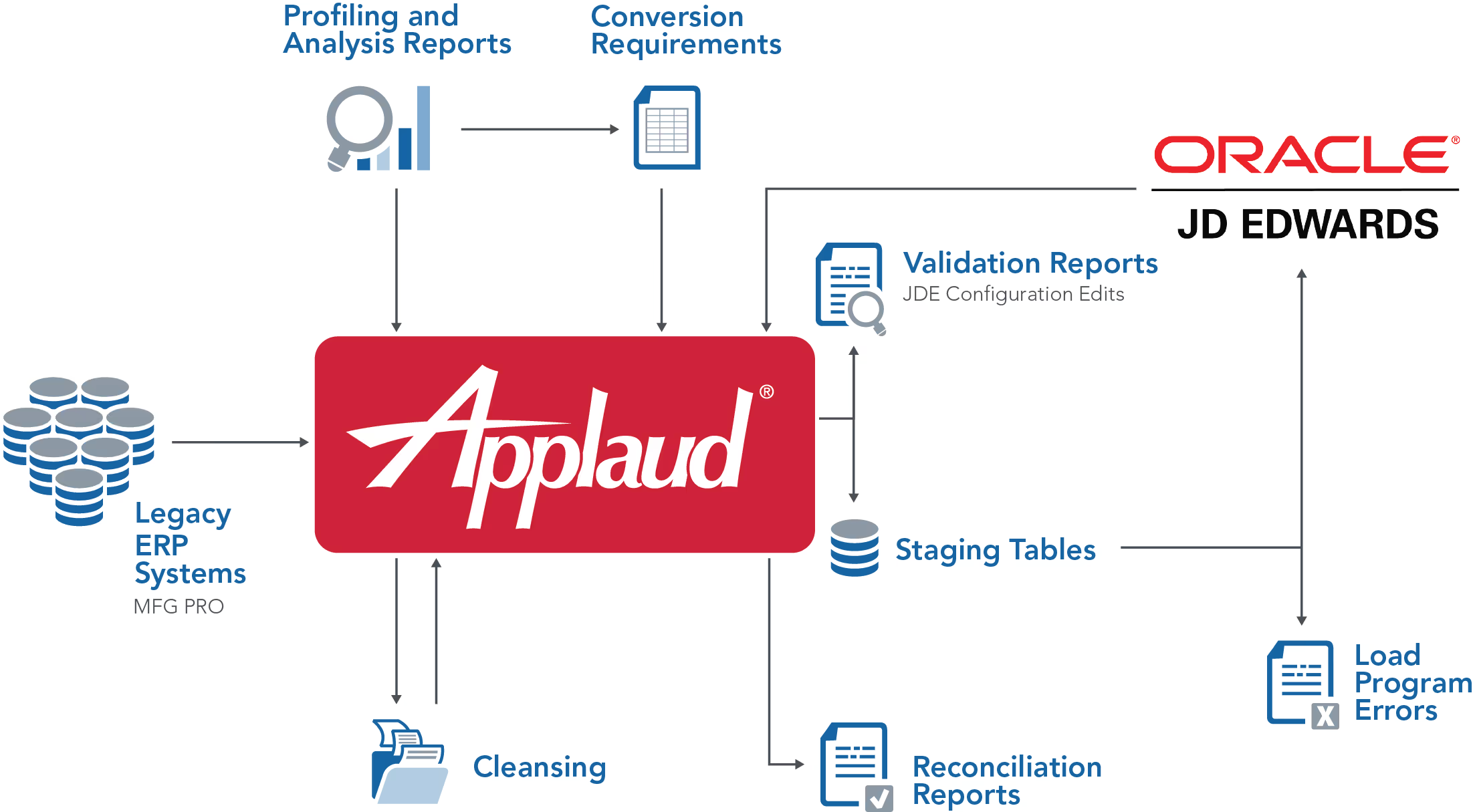
Client Challenges & Solutions
The rescue effort was made possible through the combination of Definian’s approach, experience, and software.
The business requirements for the Sales Order and Purchase Order conversions were not complete.
- Applaud’s automated profiling capabilities immediately provided an overview of the legacy data landscape and identified missing data migration specifications.
- Applaud’s robust library of conversion code and pre-built validation tools provided a head start developing a conversion solution for the client.
- Definian consultants’ extensive experience on data migration projects and knowledge of JDE E1, made it possible to identify data issues and technical gaps even before the client finished the papers for granting access to the target applications.
In addition to understanding how legacy data structures map to JDE E1, there were data exceptions and configurations that needed to be understood prior to transformation and load.
- Both technical and functional validations were incorporated into the conversion programs, providing clear and actionable error messages for the team to address legacy data issues, incomplete migration specifications, and missing configuration.
- Applaud’s integrated platform made it possible to extend data profiling and analysis reports to automate many data cleansing activities, further reducing the amount of manual work needed for cutover.`
Prior to Definian joining the project, the client’s project management was highly doubtful that the migration programs would be ready for go live.
- Definian’s experienced consultants created a detailed data migration strategy and incorporated this into the project plan to ensure that the project would be ready for go-live.
- Applaud’s rapid application development platform made it possible for data conversions to be built in mere days, allowing ample time to identify and correct for issues in the initial requirements.
- Our specialization in data migration gave us the confidence to reassure project leadership that while their situation is unique, Definian has the skills and tools necessary to take on the challenge, understand their data landscape, and make go-live successful.
The Bottom Line
The Results
One week prior to go live, the Sales Order and Purchase Order conversion development was complete, fully tested, and highly automated. Definian’s approach made it possible to identify and requisition legacy and target data issues ahead of time, avoiding issues at go-live. Detailed validation and reconciliation reports streamlined approvals and signoffs during cutover and enabled the client team to gain full confidence in the converted data. Through a combination of our EPACTL approach, Applaud’s technical capabilities, and our decades of consulting experience in data migration, we were able to define a data conversion approach and guide the client to success.
With only 100 hours of work over the course of 38 calendar days, Definian
was able to turn the project from certain failure to an uneventful go live, with no major issues encountered at cutover. Whereas data migration was once the biggest cause of concern for the project team, by go-live it was a reason for celebration.
The Applaud® Advantage
In order to rescue the project, the Client decided to use Definian’s Applaud® data migration Services to ensure the transactional migrations would be ready for Go
Live without impacting the project timeline. Three key components of Definian’s Applaud solution helped the client navigate their data migration:
- Definian’s data migration consultants: Definian’s services group averages more than six years of experience working with Applaud, exclusively on data migration projects.
- Definian’s methodology: Definian’s EPACTL approach to data migration projects is different than traditional ETL approaches and helps ensure the project stays on track. This methodology decreases overall implementation time and reduces the risk of the migration.
- Definian’s data migration software, Applaud®: Applaud was built from the ground up to address the challenges that occur on data migration projects, allowing the team to accomplish all data needs using one integrated product.
All three aspects of the solution were critical factors in meeting the tight time frames required to rescue this project.
Two Critical Benefits of a Data Repository
Data is always underestimated on new implementations. From the initial data design, to data quality, the migration, and through the final data validation, this underestimation of data is the one constant during my 5+ years of being a data migration consultant. This underestimation frequently increases the risk that the data will cause projects to be delayed. There are several choices a project team can make to minimize the risk behind data migration, some more obvious than others. When rescuing projects, we often find one risk mitigation technique missing: a centralized data repository.
A data repository is a general term used to refer to a destination designated for data storage. Many IT experts use the term to refer to a specific setup within an overall IT structure, such as a group of databases, a data warehouse, a data lake, etc. Most of the existing literature focuses on how a data repository is key for data analytics and reporting. In addition to analytics, data repositories provide significant benefits within the data conversion space. Two important benefits are cross system translation and the ability to take an external snapshot.
Cross System Translation
One of the biggest benefits of having a centralized repository is that it allows all data sources to exist together in one place. These data sources not only include data from legacy systems, but any supplemental data, like cross-references and data stored on flat files. Once all the data is in the single location, conversion, analytics, and reporting can occur without worrying about the impact on the existing production systems.
One critical type of analysis that is frequently performed is cross system de-duplication. Duplicates within and across the data landscape have both technical and business impacts. Technically, duplicated data across key fields will not load in most cases. This results in missing/incorrect attributes and significant extra work, usually under high pressure, to get resolved. A larger concern is the impact of duplicated data that does not get cleaned and gets loaded. This duplicated data can directly and severely impact organization's bottom lines. One Client estimated that they would save 30% annually, 10s of millions of dollars, on their raw material purchases once their suppliers and items were de-duplicated.
Another added benefit of converting from a data repository is it facilitates an easier way to account for cross system migration rules. A Client was migrating several disparate legacy systems to Oracle Cloud ERP. They stored supplier data in a Rollcim database and purchase order data in an Infor database for a single business entity. The business rules for conversion was to select the suppliers with open purchase orders. With the supplier and purchase order data in different systems, the central location made it simple to execute the selection and identify integrity issues between Infor and Rollcim well before each test cycle and go-live.
External Snapshot
A second risk reducing benefit of the data repository is that it naturally facilitates the ability to take an external snapshot. This snapshot of data contains all legacy data sources, supplemental data sources, pre-conversion data from the target applications including configuration, and post conversion data from the target applications. These snapshots are completely frozen and stable. This stability provides a solid reference point for questions and a base for all downstream conversion activities.
One large benefit of having this solid reference point is that it can facilitate a large portion of the data validation process. It does this by making data at each stage of the migration available for review. By having data at all stages at different points in time, it is possible to directly compare the legacy and the post converted data without having to worry about data changes over time. The centralization of data accelerates the validation process by providing all relevant data as it was at the time of conversion.
In addition to having the data landscape captured through an individual conversion cycle, the repository also can preserve the data at multiple points in time throughout the entire implementation. This allows the team to compare the converted data from test cycle to test cycle, preventing the need to re-validate data that’s already been validated, ensuring that the expected record counts are accurate, and quickly assess all enhancements to the conversion business requirements.
In Conclusion
A central data repository is a critical part of Definian’s Best Practices and a key feature of our data migration software, Applaud®. We often rescue struggling implementations and one of several commonalities of these projects is that none of them utilized a centralized repository (read rescue story). One of the first things that we do when a Client is struggling, is implement our repository so we can immediately analyze the data landscape to understand the current issues. The power and effectiveness of having a central repository can have immeasurable impact on implementations.

Consolidating 10 Legacy ERPs Into Oracle EBS for a $22.5B Manufacturing Conglomerate
Project Summary
A leading $22.5B Diversified Manufacturing Conglomerate grew through the years by acquiring companies. They needed help consolidating their global footprint into a single enterprise resource planning (ERP) system. In order to simplify and standardize back-office processes and leverage resources across the global enterprise, a major project was initiated to consolidate ten disparate legacy systems into a single instance of Oracle E-Business Suite (EBS) R12. This case study represents one phase of the implementation, though the requirements and challenges pertained to every phase of the implementation.
“…using Definian was 4 to 5 times more productive than our traditional approach.”
– Director, ERP Data Conversion
Requirements
The overall data migration requirements for this phase of the implementation were as follows:
- The data from ten legacy ERP systems needed to be extracted, analyzed, enriched, and transformed before it could be loaded into a single instance of Oracle EBS. De-duplicated records needed traceability for auditors.
- Complex data transformation programs needed to be ran consistently to support various test cycles. Enhancements and changes needed to be easily identifiable, and metrics between cycles were expected to be tracked and improved upon.
- Due to the nature of the client’s businesses, strict auditing requirements needed to be met. Records needed to be traceable through conversion programs, and complex transformations needed to be fully documented for approval.
Client Challenges
There were many obstacles to making this data migration successful. Some of the most notable challenges included:
- The database technology running many of the legacy systems was old and outdated, including a 30-year-old mainframe and an Oracle 8i database that was nearly 20-years old.
- Significant data quality issues existed across the data landscape, including missing, invalid, inconstant, and large amounts of duplicated data.
- Data structures were incredibly different--both between legacy systems and from each legacy system to the target Oracle EBS solution. Complex data transformations were required.
- Project timelines were tight and specification changes were frequent. With no slack in the time line, each new specification needed to be implemented quickly by the data team and easily validated by the testers.
- Due to large data volumes, complex data transformations, and rigid timelines, invalid data sets needed to be preemptively identified prior to loading data into Oracle EBS.
Applaud® for the Data Migration
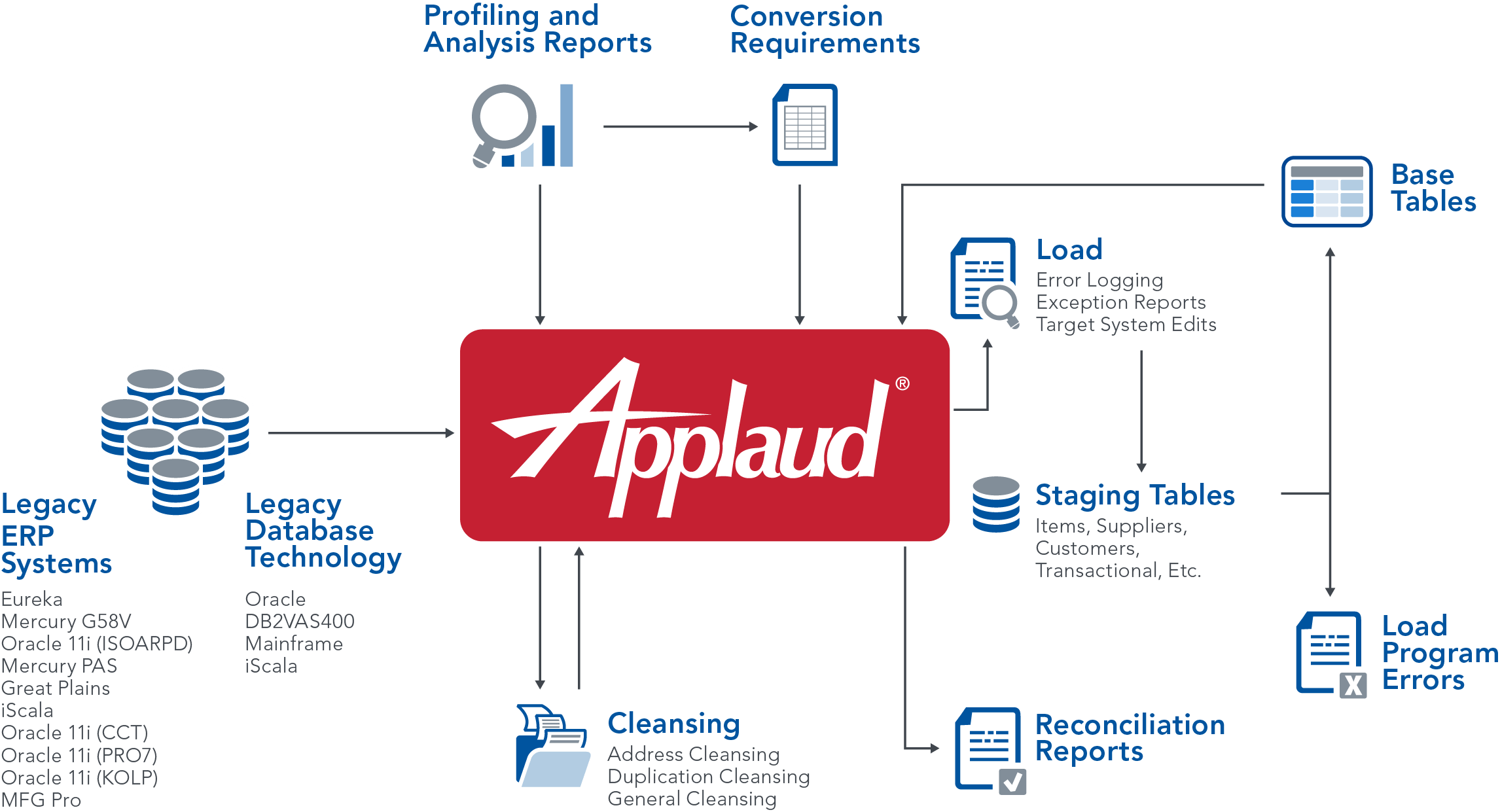
Key Activities
- Despite the lack of client resources with knowledge of the mainframe or Oracle 8i systems, data was extracted from ten different legacy sources into a single data repository within Applaud.
- Built-in profiling tools allowed the team to proactively review the existing data landscape, which helped drive requirement discussions based on facts instead of data assumptions.
- The combination of Applaud’s data migration hub and automated data analysis capabilities identified duplicated and other data quality issues across the disparate systems.
- An extensive data quality strategy that was facilitated through a combination of dashboards, detailed reports, and Applaud’s comprehensive quality tools enabled the business to focus their energy on making decisions rather than cleansing individual records in the legacy systems.
- Data transformations built in Applaud enabled the team to quickly react to requirements changes and ensured that the entire process was predictable, repeatable, and highly automated.
- Data transformations built in Applaud enabled the team to quickly react to requirements changes and ensured that the entire process was predictable, repeatable, and highly automated.
- The migrated data was reconciled against the legacy data, providing both an audit trail and a method to quickly validate large portions of the converted data.
- Data migration activities across all divisions and phases flowed through a centralized team, ensuring all requirements and processes were consistent across the entire organization.
The Bottom Line
To help overcome these challenges, the client seriously considered several alternatives, including internal resources and Informatica. After a “bake-off” with a global consulting firm using the Informatica software, the client chose Definian Applaud® data migration services as their data migration solution.
Three key components of Definian’s Applaud solution helped the client navigate their data migration:
- Definian’s data migration consultants: Definian’s services group averages more than six years of experience working with Applaud, exclusively on data migration projects.
- Definian’s methodology: Definian’s EPACTL approach to data migration projects is different than traditional ETL approaches and helps ensure the project stays on track. This methodology decreases overall implementation time and reduces the risk of the migration.
- Definian’s data migration software, Applaud®: Applaud has been optimized to address the challenges that occur on data migration projects, allowing the team to accomplish all data needs using one integrated product.
All three aspects of the Applaud solution were needed in order to resolve the challenges of this project.
The Results and Future Plans
The end result of using Definian’s Applaud data migration services was a successful implementation. The Definian team was able to exceed expectations not only in delivering the migration on time and on budget, but through several other measurable metrics. In addition to the successful cutover, Definian was able to reduce critical path timeline by 1.5 months, enable the client to re-allocate 4 to 5 internal resources, and improve the KPIs of the entire project team by 50%. Without Definian, it would have been unlikely that the client would have been able to accomplish everything that was needed in the required timeframe. Bringing Applaud into the project drastically reduced the risk of failure.
Since the completion of the initial phase of the implementation, the client has continued to leverage the Definian team for all subsequent phases of their overall implementation as they continue to successfully and seamlessly deploy across the globe. While the implementation is still ongoing, to date, the team has migrated data from 58 legacy sources across 39 sites in 17 countries.

Data Monetization Services
Data monetization is powerful way to drive value from data assets. It is possible to monetize data indirectly by finding ways to reduce costs, manage risk, and improve operational efficiency. Conversely data can be monetized by selling data, delivering data-enabled services, or building new data products. For companies to realize these data monetization goals, they will need to answer some hard questions, including:
- How do I determine the value of my data?
- How can I drive more value from my data?
- How can I master regulatory compliance and manage risk?
- How can I demonstrate the quality and integrity of my data?
- How can I share data reliably and legally?
At Definian, we help organizations discover new opportunities for monetizing their data and implement disciplined processes to help you realize your business goals. We draw on our cross-disciplinary expertise in data management, regulatory policy, and finance to help you explore data monetization use cases and implement processes that are well-governed and compliant.
Disciplined Discovery
Our five-step advisory service helps executives and other stakeholders uncover new ways of thinking about your data, build an inventory of use cases, and align your data monetization tactics with the strategic goals of your business.
Step 1: Identify Stakeholders
Step 2: Build an Inventory of Use Cases
Step 3: Develop Business Cases
Step 4: Execute Initiatives
Step 5: Realize Business Benefits
Risk Mitigation
Quickly driving value from data is attainable by understanding the impact of new and emerging regulatory requirements. Our advisory staff, many of them legal engineers, help your organization implement data monetization strategies that meet the most stringent regulatory policies—saving you time and money and reducing the risk involved in new data initiatives. We have expertise in these critical areas:
Banking and Finance
- Current Expected Credit Loss (CECL)
- Comprehensive Capital Analysis and Review (CCAR)
- Anti-Money Laundering (AML)
- Office of Foreign Assets (OFAC)
- Financial Crimes Enforcement Network (FinCEN)
- Community Reinvestment Act (CRA)
Sensitive Data Management
- California Consumer Privacy Act (CCPA)
- EU General Data Protection Act (EU GDPR)
- Children’s Online Privacy Protection Act (COPPA)
- Video Privacy Protection Act (VPPA)
Data monetization services from Definian can help you leverage data and information to increase revenues, reduce costs, and drive competitive advantage while mitigating risk.
Data Migration Services for Workday Implementations
Data Migration Overview
Whether it is Human Capital Management (HCM), Finance, or Student, the implementation of a Workday system is a major undertaking and data migration is a critical and risky component.
- Data from multiple legacy sources needs to be extracted, consolidated, cleansed, de-duplicated, and transformed before it can be loaded into Workday.
- The data migration process must be repeatable, predictable, and executable within a specific timeframe.
- Migrated data needs to be reconciled against the legacy source data after loading to Workday.
- Issues with data migration will delay the entire implementation or Workday will not function properly.
- If the converted data is not cleansed and standardized, the full functionality and potential Workday has to offer will not be realized.
Data Migration Challenges
Many obstacles are encountered during a Workday implementation, each increases the risk of project overrun and delay. Typical challenges include:
- High levels of data duplication across disparate legacy systems.
- Unsupported and/or misunderstood legacy systems, both in their functionality and underlying technologies.
- Legacy data quality issues – including missing, inconsistent, and invalid data – which must be identified and corrected prior to loading to Workday.
- Legacy data structures and business requirements which differ drastically from Workday’s.
- Frequent specification changes which need to be accounted for within a short timeframe.
The Definian Difference
Definian’s Applaud® Data Migration Services help overcome these challenges. Three key components contribute to Definian’s success:
- People: Our services team focuses exclusively on data migration, honing their expertise over years of experience with Applaud and our solutions. They are client-focused and experts in the field.
- Software: Our data migration software, Applaud, has been optimized to address the challenges that occur on data migration projects, allowing one team using one integrated product to accomplish all data objectives.
- Approach: Our RapidTrak methodology helps ensure that the project stays on track. Definian’s approach to data migration differs from traditional approaches, decreasing implementation time and reducing the risk of the migration process.
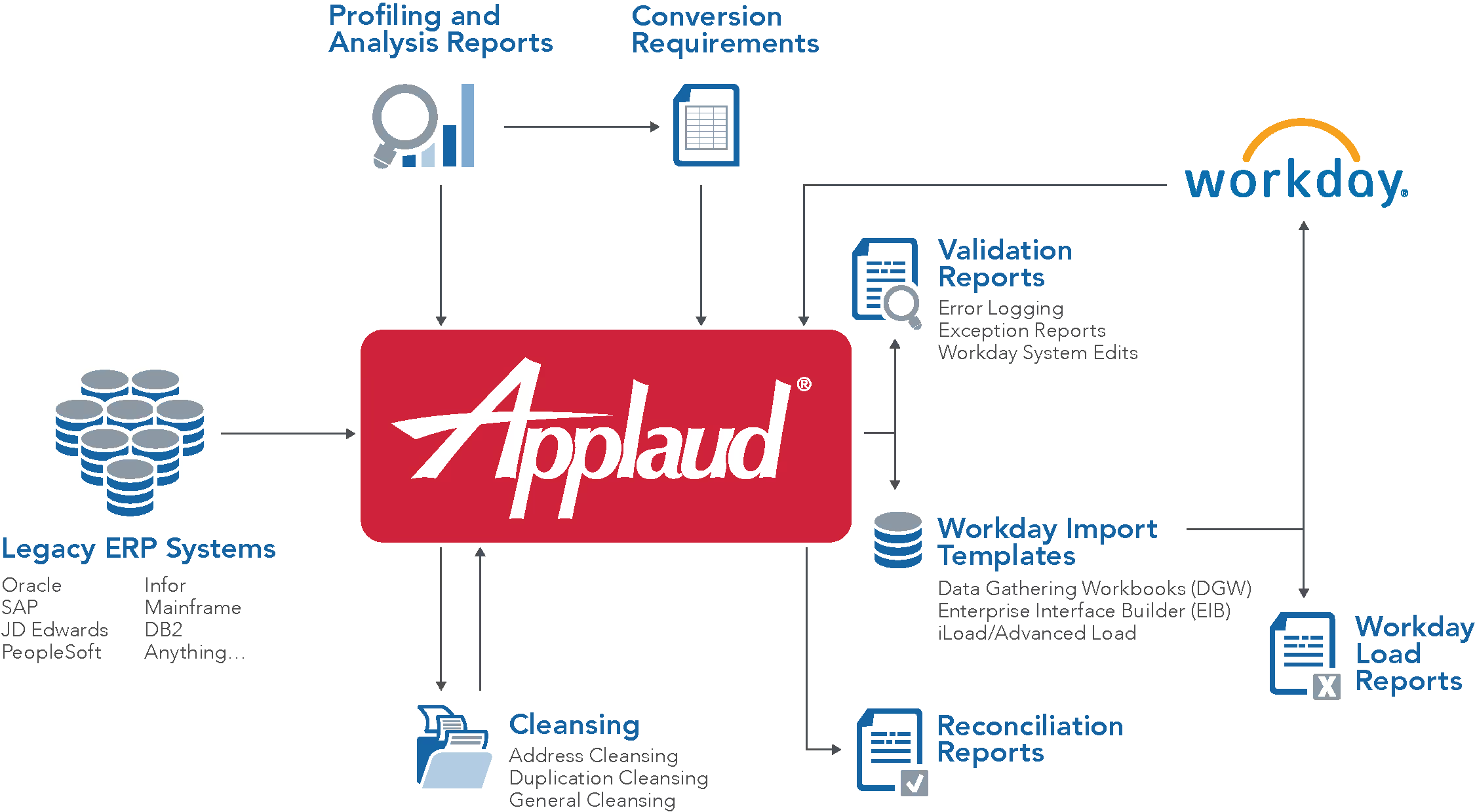
Applaud Eliminates Data Migration Risk
Applaud’s features have been designed to save time and improve data quality at every step of an implementation project. Definian’s proven approach to data migration includes the following:
- Experienced data migration consultants identify, prevent and resolve issues before they become problems.
- Extraction capabilities can incorporate raw data from many disparate legacy systems, including mainframe, into Applaud’s data repository. New data sources can be quickly extracted as they are identified.
- Automated profiling on every column in every key legacy table assists with the creation of the data conversion requirements based on facts rather than assumptions.
- Powerful data matching engine that quickly identifies duplicate information across any data area including employee, dependent, customer, and supplier records across the data landscape.
- Integrated analytics/reporting tools allow deeper legacy data analysis to identify potential data anomalies before they become problems.
- Cleansing features identify and monitor data issues, allowing development and support of an overarching data quality strategy.
- Hundreds of out-of-the-box pre-load validations identify issues within the legacy data and its compliance with Workday configuration prior to the upload into Workday.
- Development accelerators facilitate the building of Workday EIB, Advanced Load and Data Gathering Workbooks (DGW).
- Process that ensures the data conversion is predictable, repeatable, and highly automated throughout the implementation, from the Foundation through the Gold tenant.
- Complete gross-to-net payroll reconciliation process that can be used during the payroll parallel tests allow the client to reconcile every line from every paycheck for every employee down to the penny, presented in a meaningful way to payroll managers.
- Stringent compliance with data security needs ensure PII information remains secure.
- Our RapidTrak methodology provides a truly integrated approach that decreases the overall data migration effort and reduces project risk.
EPACTL vs ETL
Industry experts agree that Data Migration poses the largest risk in any implementation. The findings are the same across platforms (SAP, Oracle, Workday, etc), infrastructure model (Cloud, On-Premise) and module (ERP, HCM, MRP, etc). There are countless stories of implementations suffering delays, overruns, and even outright failure stemming from Data Migration problems.
Organizations often do not realize the complexity of Data Migration. Executives often feel that this is, or should be, a simple task, leading to the fatal oversimplification of "It's just moving data.” This mindset is a leading cause of subsequent problems.
“More than 80% of Data Migration projects run over time and/or over budget. Cost overruns average 30%. Time overruns average 41%.”
— The Bloor Group
Underestimation leads organizations to approach Data Migration as if it were no different than a Data Integration project, tackling it with traditional ETL (Extract, Transform, Load) tools.
While ETL tools and methodologies are sufficient for Data Integrations, they fall short in adequately meeting the increased complexity and additional requirements of Data Migration.
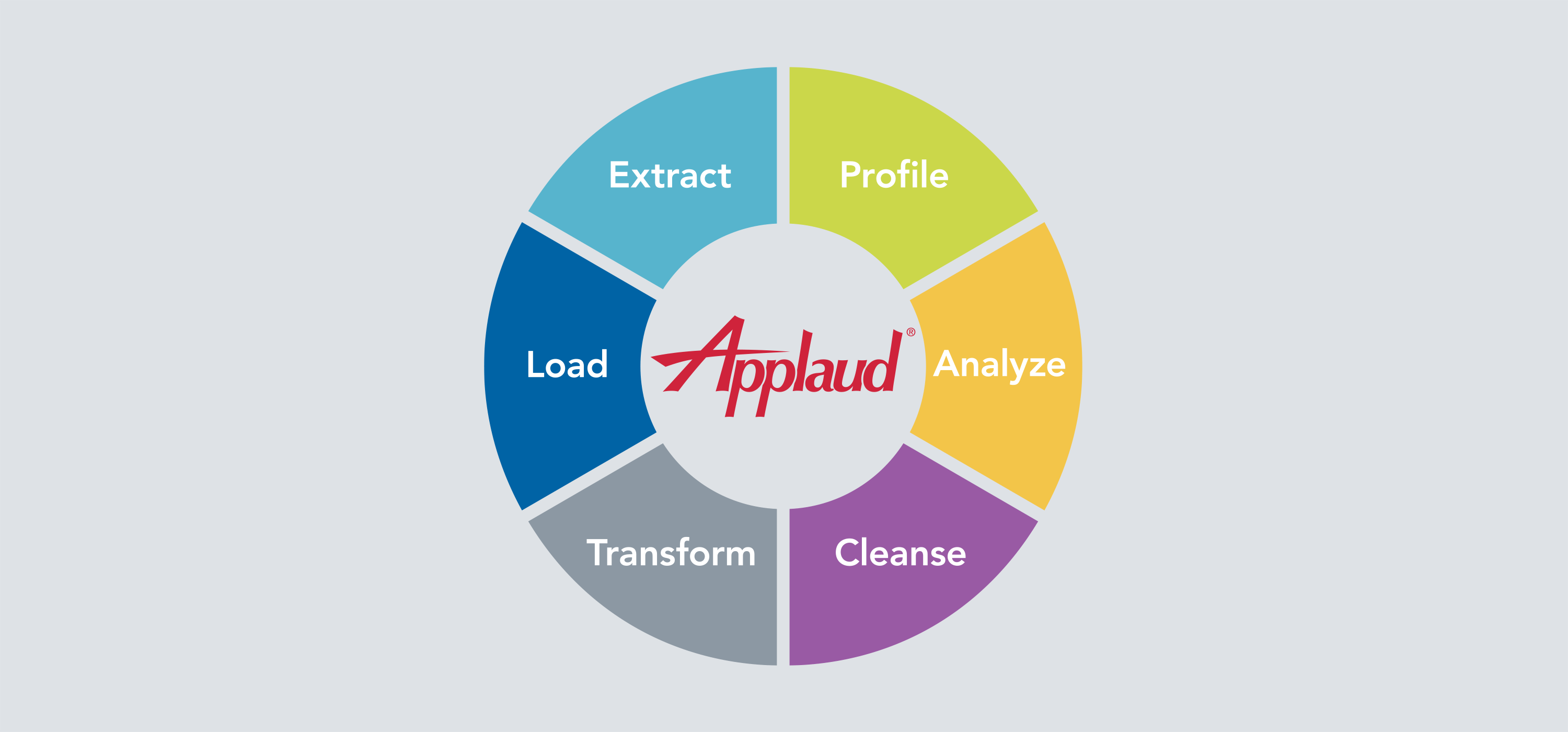
To eliminate the risk of failure that Gartner, Bloor, and other industry pundits have identified, a different type of tool and approach is needed. To successfully navigate the complexities of Data Migration, an EPACTL (Extract, Profile, Analyze, Cleanse, Transform, Load) solution is recommended.
EPACTL is designed to complete each component activity required by a Data Migration. One team using one software product handles all data needs, from the initial extraction through the post conversion reconciliation:

Data Migration projects tend to reflect a high level of complexity. Having a unified EPACTL approach enables the successful management and implementation of these requirements and significantly reduces the risk of the Data Migration.

Data Migration vs. Data Integration
Data Migration and Data Integration are mission critical aspects of today’s business application landscape, each serving different needs.
- Data Migration: The one time transference of data which occurs when implementing a new application
- Data Integration: The ongoing transference of data between applications which keep the business running on a day to day basis.
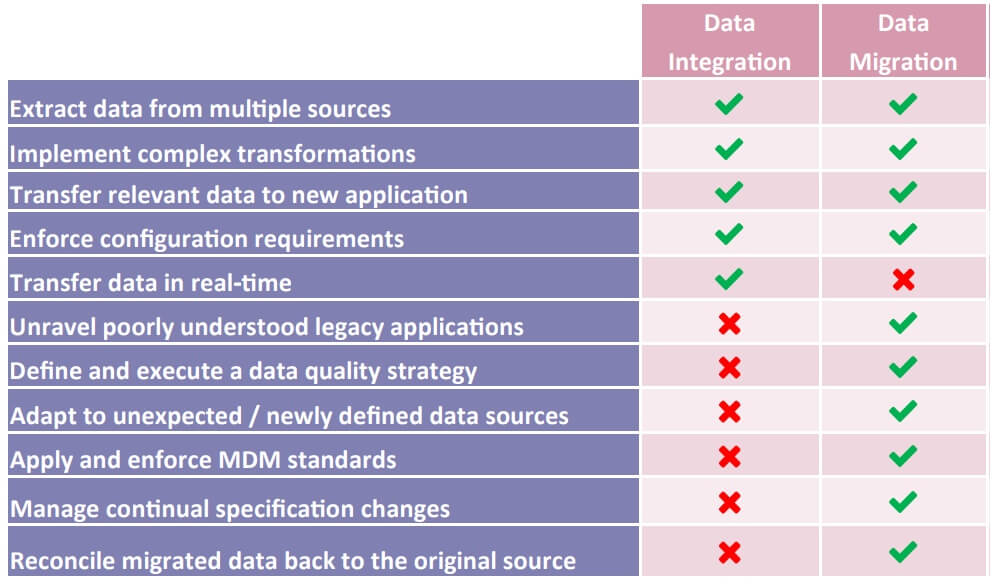
While Data Migration and Data Integration are related, they are two fundamentally different activities with contrasting requirements. They need to be approached as such. When Data Migration is treated like Data Integration, the risk of failure greatly increases. There are several factors which contribute to this reality, but a primary driver is a failure to use tools specifically tailored to meet the unique needs of Data Migration.
Similarities between Data Migration and Data Integration stop with the transference of data. While Data Integration has the additional requirement of being able to transfer data in real or “near-real” time, Data Migration encompasses a number of additional complexities.
Complexity on Data Migration projects often coalesce around being able to identify, understand, and address unknowns.
“83% of all data migration projects either fail outright or cause significant cost overruns and/or implementation delays.”
— Gartner
Frequent unknowns encountered in Data Migration include under-documented legacy data structures, legacy data values, data quality issues, and ever changing business requirements. These unknowns turn a “simple” Data Migration into a Data Integration initiative, a business requirement gathering project, a data quality project, a master data management project, a data enrichment project, and a data reconciliation project.
Deploying the right people, software and approach is critical to meeting these additional requirements. If they are ignored and Migration is treated like Integration, the risk of becoming part of the 83% of projects which fail to meet their objectives in the expected timeline greatly increases.

Data Migration Services Overview
We Take the Risk Out of Data Migration
The implementation of a new ERP/HCM/PLM system is a major undertaking. Data migration is a critical and risky component of any such project
- Data from multiple data sources needs to be extracted, consolidated, cleansed, de-duplicated, and transformed before it can be loaded into the target system.
- The data migration process needs to be repeatable and executable within a specific time frame.
- Migrated data needs to be reconciled against the legacy source data after loading to the target system.
- Issues with data migration will delay the entire implementation or the new system will not function properly.
Data Migration Challenges
Many obstacles are encountered during a data migration, each increases the risk of project overrun and delay. Typical challenges include:
- High levels of data duplication across disparate legacy systems
- Old and poorly understood legacy systems and underlying database technologies
- Inconsistent legacy data quality – including missing, inconsistent, and invalid data – which must be identified and corrected prior to loading the target system
- Misunderstood or undocumented legacy data usage and customizations
- Legacy data structures which differ drastically from the target data structure
- Frequent specification changes which need to be accounted for within a short time frame
The Difinian Difference
Definian’s Applaud® Data Migration Services help organizations overcome these challenges. Three key components contribute to Definian’s success:
- Software: Our data migration software, Applaud, was built from the ground up to address the challenges that occur on data migration projects, allowing the team to accomplish all data needs using one integrated product.
- People: Our services team focuses exclusively on data migration, honing their expertise over years of experience with Applaud and our solutions. They are client-focused and experts in the field.
- Approach: Our RapidTrak methodology helps ensure that the project stays on track. Definian’s approach to data migration projects differs from traditional approaches, decreasing implementation time and reducing the risk of the migration process.
Applaud Eliminates the Risk Around Data Migration
- Experienced data migration consultants identify, prevent and resolve issues before they become problems.
- Extraction capabilities can incorporate raw data from many disparate legacy systems, including mainframe, into Applaud’s data repository. New data sources can be quickly extracted as they are identified.
- Automated profiling on every column in every key legacy table assists with the creation of the data conversion requirements based on facts rather than assumptions.
- Powerful data matching engine identifies duplicate records within and across all in scope legacy systems.
- Integrated analytics/reporting tools allow deeper legacy data analysis to identify potential data anomalies before they become problems.
- Cleansing features identify and monitor data issues, allowing development and support of an overarching data quality strategy.
- Transformation capabilities build easily repeatable data migration programs that can quickly react to specification changes.
- Our RapidTrak methodology provides a truly integrated approach that decreases the overall data migration effort and reduces project risk.


SAP to JDE Conversion for $1.5B Consumer Packaged Goods Manufacturer
Project Summary
After years of expanding and diversifying their portfolio of products and services, one of North America’s largest manufacturers of consumer packaged goods initiated a plan to convert its various acquisitions into a single instance of JDE EnterpriseOne (E1).
Project leadership established an aggressive plan to go live with JDE E1 one year from the project start date. But after 5 months of struggling with data conversion processes developed by their internal IT department, there were serious doubts about go-live readiness. Faced with hundreds of open data issues and no systematic way to solve them, the Systems Integrator (SI) partner called in Definian to rescue the project.
This case study represents the conversion of manufacturing data from SAP ECC 6.0 to JDE E1 for all North American sites.
Requirements
The overall data migration requirements for the initial phase of the Global Manufacturing Acquisition project included:
- The SAP and supplemental data needed to be extracted, consolidated, harmonized, cleansed, and transformed before it could be loaded into a single instance of JDE E1.
- Major data cleanup and complicated selection criteria was being performed manually by the client. Spreadsheets associated with these efforts needed to be incorporated into the automated conversion process.
- To guarantee that in-scope data was correctly divested from the parent SAP system, selection criteria needed to be validated against the results of queries provided by internal auditors. After the migration, the legacy data had to be fully reconciled against what was loaded into JDE E1.
- Reports needed to be built to assist the business in identifying and applying changes to both SAP and JDE E1 during an extended dual maintenance window.
“Thanks so much for the efforts and the sacrifice. You guys rock.”
– CFO and EVP
Challenges
There were many challenges to making the Data Migration successful. Some of the largest challenges faced and overcome were:
- SAP source data structures were vastly different from the target JDE E1 data structures. Numerous supplemental cross-references and supporting data extracts were needed.
- Since one of the recent acquisitions was not yet off their former parent company’s system, the conversions needed to execute complex selection logic and had to be built and tested without direct access to the legacy system.
- The data conversion had been previously attempted through the use of SQL scripts, so these scripts became the basis of the selection criteria and requirements for the Applaud-based conversion routines.
- Project leadership had little confidence in the existing conversion solution. The internal team’s initial attempt for conversion development relied on SQL scripts, included almost no error reporting, and proved to be unsustainable as requirements evolved and changes were needed.
- The client organization intentionally shielded their end users from conversion requirement gathering and test cycles. This caused numerous gaps between the conversion results and the users’ expectations.
- The conversion schedule was extremely tight. Test runs were scheduled every two weeks, which did not allow for thorough and complete testing, nor for the testers to request changes based on analyzed test results.
- Numerous last-minute requirements forced changes to be made to transactional conversions during the final week before go-live, leaving virtually no time for business users to validate changes.
Applaud® for Data Migration
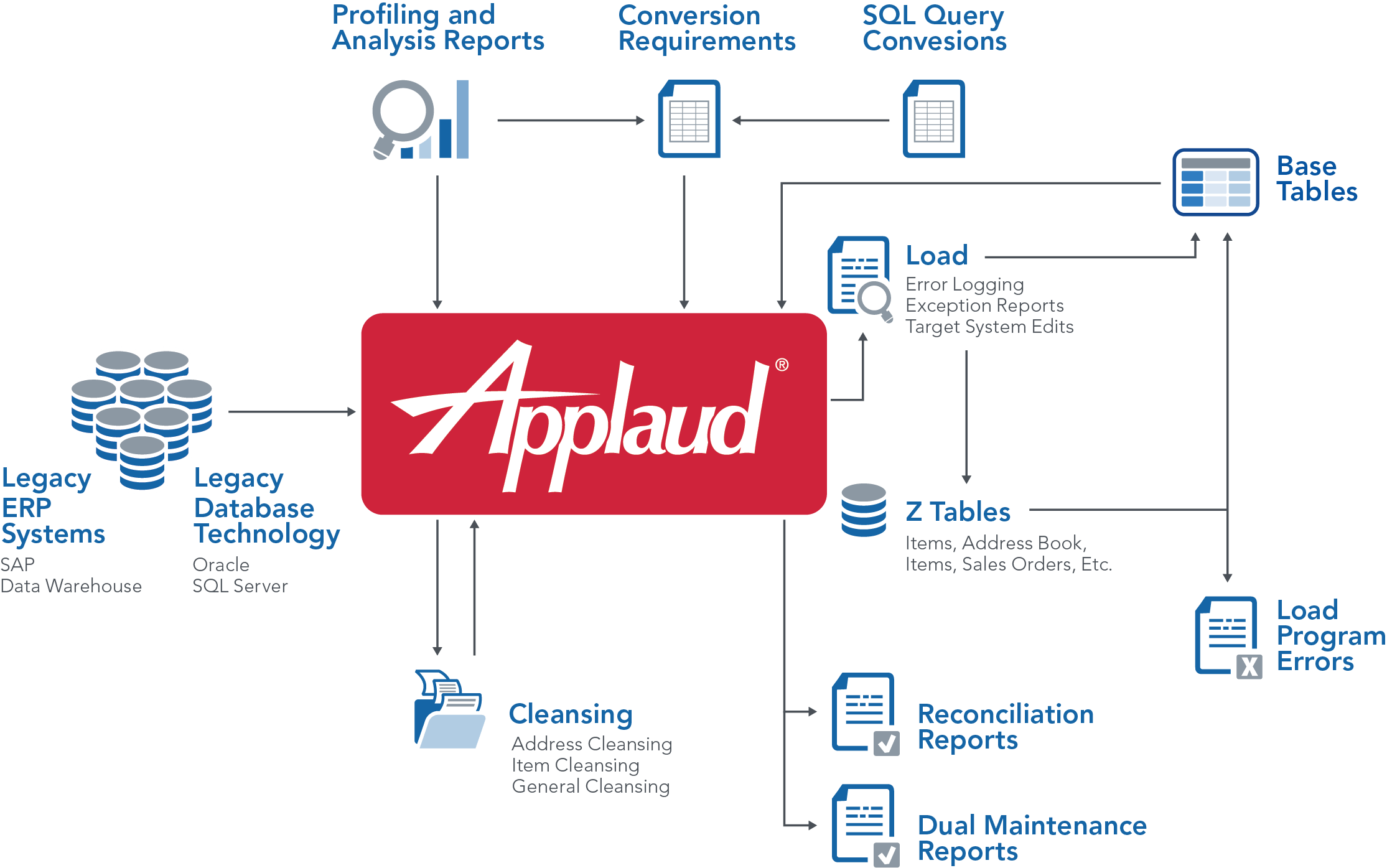
Key Activities
- The team began by using Applaud’s integrated analytics and reporting tools to perform a deep analysis on the legacy data and proactively identify legacy data issues.
- Data ran through Applaud standardization, consolidation, correction, and enrichment processes both before and as problem areas were identified, improving the overall quality of the data prior to go-live.
- Instead of basic “lift and shift” SQL queries, 51 fully integrated transformation and migration processes were created and executed within Applaud.
- The project timeline was maintained as additional requirement changes were identified and incorporated using Applaud’s rapid development capabilities.
- The team replicated in-scope portions of the data landscape in a centralized data repository. Combining previously disparate data sources made data harmonization and validation efforts more efficient.
- Robust and thorough error reporting was handled via the built-in cleansing tools; this allowed the team to proactively identify and rectify failures before loading data to the target JDE E1 tables.
- Developed extensive financial validation reports, and reconciled business SQL queries to the converted data out of Applaud.
- The error and validation reports served as platforms for comparing the target JDE E1 production data with the source SAP production data, which became especially helpful during the dual maintenance activities.
- Definian’s RapidTrak methodology was used to manage the various conversion interdependencies, decreasing the overall data migration effort and reducing project risk.
The Bottom Line
The Results


Applaud’s integrated platform immediately provided insights into the data landscape, drove creation of reports and KPI’s, enabled rapid development of complex conversion programs, and ultimately made it possible to load, validate, and reconcile data for 51 different conversions.
Even though Definian consultants entered the project mid-flight, they were able to pick up complex yet untested SQL conversion where internal resources left off, without sacrificing progress already made. This allowed for a more holistic data migration approach that included legacy data cleansing and post conversion reconciliation.
By taking over conversion responsibility, Definian enabled a previously overwhelmed internal team to focus on deliverables that will have lasting impact, like reporting, integrations, and training. 7 months after Definian began work, the entire team celebrated a successful JDE EnterpriseOne go-live for all North American sites, on time and on budget.
The Applaud® Advantage
To help overcome the expected data migration challenges,the organization engaged Definian Applaud® data migration services to eliminate the risk from their data migration and ensure the overall success of their consolidation project.
Three key components of Definian Applaud solution helped the client navigate their data migration:
- Definian’s data migration consultants: Definian’s services group averages more than six years of experience working with Applaud, exclusively on data migration projects.
- Definian’s methodology: Definian’s EPACTL approach to data migration projects is different than traditional ETL approaches and helps ensure the project stays on track. This methodology decreases overall implementation time and reduces the risk of the migration.
- Definian’s data migration software, Applaud: Applaud has been optimized to address the challenges that occur on data migration projects, allowing the team to accomplish all data needs using one integrated product.
All three aspects of the solution were critical factors in meeting the tight time frames required to rescue this project.

What's Your Type? A Nontechnical Primer on IT Transformation Cutover Types
Every successful IT Transformation includes a cutover – a moment where the old way of doing things disappears and the new solution goes live. The right one for your enterprise depends on the amount of time you can shut down operation of the old system, your aversion to risk, the business need of a speedy transformation, and more. Here, we introduce the basic types of cutover and a few benefits and risks associated with each one.
Big Bang
Explained:
A big bang approach will transform your enterprise overnight. With this cutover type, you turn off the legacy system, extract and transform data for all modules, and load to the target system. When the rest of the business arrives for work the next day, the legacy system is retired (retained only for history) and the new system is live.
Benefits:
Going big means you can capitalize on your investment earlier. When the entire company moves to the new system (ERP, HCM, PLM, etc.) you immediately have better data governance, a higher level of automation, and greater integration of departments across your enterprise.
Big Bang is the cleanest approach because no custom interfaces between the legacy and target systems need to be built. Likewise, there are no dual maintenance activities across the legacy and target system.
Psychologically, big bang is the most powerful. The entire enterprise (not just a few departments at a time) are aligned towards a goal, and when cutover begins, it is like watching a rocket launch.
Warnings:
This approach has the longest cutover window. For example, this is not feasible for hospitals or companies that ship every hour of every day (think Amazon). Also, the workforce needs to be prepared – that means heavy investment in training on the new system long before cutover since there is no intermediary phase where users can rely on the legacy system.
Phased by Business Unit
Explained:
Phasing by business unit means having separate parts of your company implement the new solution one after another. This means multiple smaller rollouts, each one including all modules of the new ERP but limited to one business unit.
Benefits:
Phasing rollouts by business unit allow your enterprise to have a pilot program for the new ERP. This pilot program can be used to prove out the solution (important if you are an early adopter of the new system) or provide training across the enterprise.
For a company that grows by acquisition, phasing rollout by business unit is an obvious choice. Lessons learned in the first implementations enable smoother implementation and better planning for later implementations.
Warnings:
It is likely that some data exists across business and will require dual maintenance. If you are a university, this could be a professor who works at multiple campuses. If you are a manufacturer, it could be a finished good that is produced at multiple plants.
By necessity, phased rollouts require more time. No matter how strong your project management skills are, you will still need separate integration test cycles and quality assurance for every phase. These integration cycles add weeks and months to your overall schedule.
Phased by Module
Explained:
Phasing by module means having different functional areas migrated to the new system at a time. For example, Financials can be brought over to the new ERP, followed by Manufacturing, followed by Human Resources.
Benefits:
Phasing your implementation this way allows you to go-live with relatively straightforward modules first. For example, your company could have a heavily customized legacy solution for manufacturing but straightforward financials. In this case, architecture and configuration for Finance can be completed long before Manufacturing so implementing Finance early makes sense.
Warnings:
Many of the same drawback from Big Bang apply here, albeit limited to module.
Some level of integration between the legacy and target systems need to be built, but since this is only across modules (not within modules) integration is less significant than if it was Phased by Business Unit.
Big Bang Plus Delta
Explained:
This approach has a large amount of data weeks ahead of the actual cutover, then a smaller delta conversion occurs during cutover. Typically, this means that higher volume master data is migrated early making a shorter cutover window possible. The true cutover would then handle updates and additions to the previously converted data. Smaller master data sets and open transactions (such as Open Sales Orders) would be handled exactly one time at cutover.
Benefits:
Migrating master data early makes timing less of a concern. The validation teams can be given enough time to audit converted data without delaying the schedule. This approach enables large enterprises to have shorter cutover windows than if they attempted a true Big Bang cutover.
Warnings:
Migrating data into the new environment early (before go-live) means that dual-maintenance is required between the old and new system. Consequently, a manual effort or more complex automated conversion programs are needed to ensure data integrity is maintained between the initial conversion and go-live.

The Power of the Click
Ahem ...
CLICK IT!
(You know you want to.)
Partners & Certifications