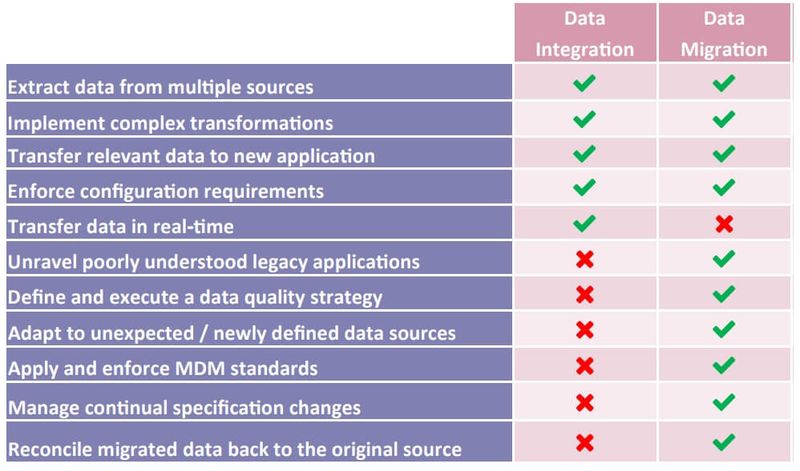


Data Migration and Data Integration are mission critical aspects of today’s business application landscape, each serving different needs.
- Data Migration: The one time transference of data which occurs when implementing a new application
- Data Integration: The ongoing transference of data between applications which keep the business running on a day to day basis.
While Data Migration and Data Integration are related, they are two fundamentally different activities with contrasting requirements. They need to be approached as such. When Data Migration is treated like Data Integration, the risk of failure greatly increases. There are several factors which contribute to this reality, but a primary driver is a failure to use tools specifically tailored to meet the unique needs of Data Migration.
Similarities between Data Migration and Data Integration stop with the transference of data. While Data Integration has the additional requirement of being able to transfer data in real or “near-real” time, Data Migration encompasses a number of additional complexities.
Complexity on Data Migration projects often coalesce around being able to identify, understand, and address unknowns.
“83% of all data migration projects either fail outright or cause significant cost overruns and/or implementation delays.”
— Gartner
Frequent unknowns encountered in Data Migration include under-documented legacy data structures, legacy data values, data quality issues, and ever changing business requirements. These unknowns turn a “simple” Data Migration into a Data Integration initiative, a business requirement gathering project, a data quality project, a master data management project, a data enrichment project, and a data reconciliation project.
Deploying the right people, software and approach is critical to meeting these additional requirements. If they are ignored and Migration is treated like Integration, the risk of becoming part of the 83% of projects which fail to meet their objectives in the expected timeline greatly increases.