


There is a consistent pattern we see with our enterprise clients at Definian.
When an organization invests millions in data platforms, analytics tools, and AI pilots, on paper, it begins to look like a modern, data-driven enterprise. However, in practice, there are issues they face. For example,
- The CFO may not get a consistent view of cost-per-transaction across business units.
- The Chief Data Officer (CDO) may be unable to tell the board which data assets are AI-ready.
- A $2-million AI pilot may stall three months, because the training data being incomplete, duplicated, and governed by no one.
The investments are rarely misaligned. The solutions are rarely poorly defined. What is missing is a strategy to connect them. Without that integration framework, each investment pulls in a different direction, leading to more cost and complexity and less clarity.
And this gap cannot be ignored anymore.
A data strategy defines the decisions an organization makes about how it collects, manages, governs, and uses data and aligns those decisions with business objectives. Most enterprise leaders understand this conceptually. What has changed is the cost of not having one.
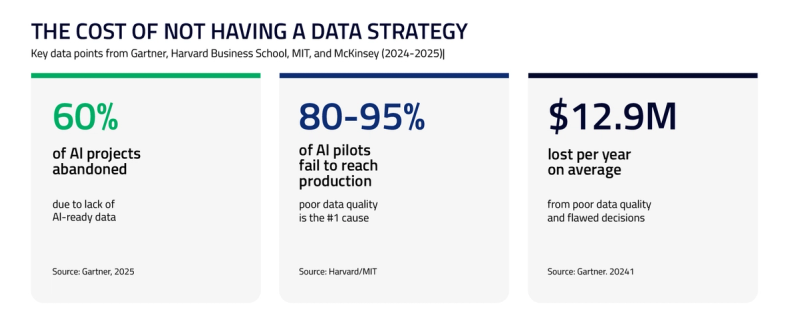
A Gartner study from 2025 predicted that through 2026, organizations will abandon 60% of all AI projects that are not supported by AI-ready data. Do they have the right data management practices for AI? 63% of them either do not have or are unsure. Meanwhile, Gartner's 2024 research estimates organizations lose at least $12.9 million a year on average, owing to operational inefficiencies and flawed decision-making caused by poor data quality. These are not just theoretical predictions, but financial realities that compound every quarter an organization operates without a coherent data strategy.
Why Data Strategy Has Become Non-Negotiable
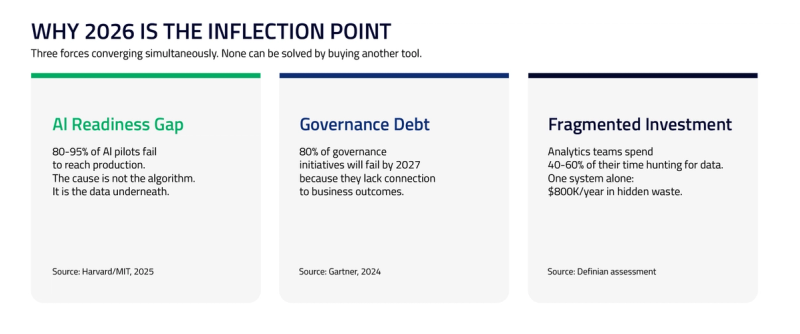
Enterprise leaders have discussed data strategy for decades. What makes 2026 different is that three forces are converging simultaneously. Also, none of them can be solved by buying another tool.
AI Demands a Data Foundation Most Organizations Do Not Have
The pressure to deploy AI is significant. Boards are asking about it. Competitors are announcing it. Vendors are selling it. However, the implementation reality is sobering.
Research from Harvard Business School and MIT consistently shows that 80–95% of AI pilots fail to reach production. When you study why they fail, the answers are remarkably consistent: poor data quality, no governance framework, undefined success metrics, and data that was never organized with AI consumption in mind.
McKinsey's 2025 State of AI report found that while 88% of companies are using AI in at least one function, only 39% report any enterprise-level impact on earnings. These are not numbers that suggest AI is too powerful or moving too fast. They suggest that organizations are deploying AI on broken foundations and wondering why it does not work.
The industry has a term for where most organizations land: pilot purgatory. The pilot worked. The demo impressed the board. Then nothing made it to production. The organizations stuck there share the same profile — AI tools deployed before anyone assessed whether the data could support them, success criteria never defined, and change management skipped because it was slower than building a demo. These are not technology failures. They are data strategy failures that surface six months after go-live.
A data strategy is what closes that gap. It defines which data assets exist, how they are governed, and whether they meet the quality thresholds that AI applications demand. Without it, every AI initiative starts from scratch: profiling data, discovering lineage, negotiating ownership. These are activities that should have been resolved long before anyone discussed algorithms.
Governance Complexity Is Accelerating
Regulatory pressure is not getting easier. GDPR, CCPA, HIPAA, CMS quality reporting, and interoperability mandates that every one of these requirements depends on knowing what data you have, where it lives, who owns it, and how it flows.
Most organizations are meeting these requirements manually, slowly, and expensively. In 2024, Gartner predicted that 80% of data and analytics governance initiatives will fail by 2027, primarily because they lack connection to business outcomes. Definian's work across enterprise implementations has shown the same pattern: disconnected from strategy, governance becomes a compliance exercise that slows the organization down rather than enabling it. A data strategy integrates governance into the operating model, so it functions as a business accelerator, not bureaucratic overhead.
Fragmented Investments Are Compounding Waste
Without a strategy, data investments soon fragment. Different business units purchase overlapping tools. Analytics teams spend 40% to 60% of their time hunting for data rather than analyzing it. At a healthcare system Definian assessed, that hidden waste reached $800,000 a year. This is not a result of failed projects or bad decisions, but from people looking for data that should already have been accessible.
And that is just the direct cost. It does not include the analytics platform sitting at 30% adoption, because people do not trust its numbers. It does not include the strategic initiative pushed back six months because nobody could agree on the data foundation.
A data strategy eliminates these patterns by establishing a data catalog, which leads to shared understanding of what data exists, who owns it, how it is accessed, and what investments are needed to support the expected outcomes.
Core Components of an Enterprise Data Strategy
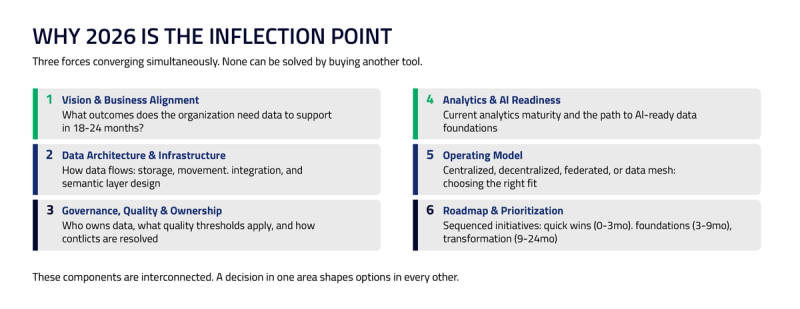
A data strategy is not a single document. It is a set of interconnected decisions that a CDO, CIO, or equivalent leader must make and align the organization around. These are the decisions that matter most:
Vision and Business Alignment
Every successful data strategy starts with business outcomes, not technology capabilities. What decisions does the organization need data to support in the next 18 to 24 months? Where is the business flying blind? What does "good" look like, and how will you measure it?
If you cannot draw a clear line from a data initiative to a business outcome, ask whether it belongs to the strategy. For organizations that get this right, success looks like "reduce financial close time from 10 days to 3 days" and not "implement a modern data warehouse."
Data Architecture and Infrastructure
Architecture defines how data flows through the organization: where is it stored, how does it move, what is connected, and what is siloed. It includes the technology stack: databases, data lakes, integration tools, and cloud infrastructure and the data models that make everything interoperable.
In 2026, architecture decisions are increasingly shaped by AI requirements. Structured and unstructured data need to coexist. Governance must extend to AI workloads. The semantic layer, a standardized business logic layer that sits between raw data and consumption, is becoming what Gartner calls a non-negotiable component of AI-ready infrastructure.
Governance, Quality, and Ownership
Governance answers the questions that make data trustworthy: Who owns this data? What does "customer" mean? Does it mean the same thing in sales, finance, and operations? What quality thresholds are acceptable? What happens when data conflicts arise?
Without governance, data becomes brittle. It breaks under the weight of every new initiative, merger, or system change. With governance, it becomes capable of absorbing change without fracturing. Definian's modernization practice builds governance into the operating model so that it scales with the organization.
Analytics and AI Readiness
A data strategy must account for how data will be consumed—not just stored and governed. What analytics capabilities does the organization need today? What does the path from descriptive analytics (what happened) to predictive analytics (what will happen) to prescriptive analytics (what should we do) look like?
For organizations that are pursuing AI, readiness is not binary; it is a spectrum. Some data domains may be AI-ready today. Others need quality improvements, governance structures, or architectural changes before they can support machine learning workloads. The strategy should map this honestly and sequence the work accordingly, connecting to insights capabilities and AI and automation initiatives with clear dependencies.
Operating Model
One of the most consequential decisions in a data strategy and one that most organizations defer too long is the operating model. How will data be managed across the enterprise?
Centralized models provide consistency but can create agility bottlenecks. Decentralized models offer speed but risk creating silos. Federated models and data mesh architectures attempt to balance both approaches, distributing ownership to domain teams while maintaining enterprise governance standards.
There is no universal answer. The right model depends on organizational structure, industry regulation, data maturity, and how many business units require autonomous access. What matters is making an explicit choice and designing governance, tooling, and roles around it.
Roadmap and Prioritization
A strategy without a roadmap is just a set of good intentions. The roadmap translates strategic decisions into sequenced initiatives with timelines, resource requirements, and measurable milestones.
Effective roadmaps balance three horizons:
- Quick wins in the first zero to three months build momentum and demonstrate value.
- Foundational capabilities in months three through nine—governance frameworks, data quality programs, architecture modernization—create the infrastructure everything else depends on.
- Transformational initiatives in months nine through twenty-four—AI deployments, advanced analytics, and data products—deliver the outcomes that the strategy was designed to enable.
A Practical Data Strategy Framework
Frameworks for building a data strategy are not in short supply, but most share a common weakness. They describe what a strategy should contain, without addressing how to build one in a real organization with political complexity, legacy constraints, and limited bandwidth.
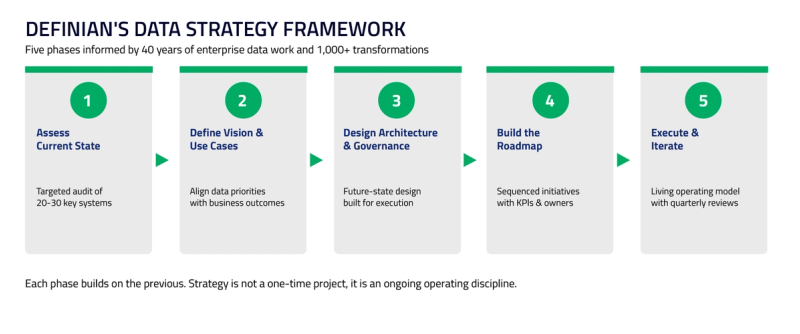
At Definian, the approach is built around five phases, informed by 40 years of enterprise data work and over 1,000 transformations across industries.
1. Assess Current State
Start with what you have, not what you want. Conduct a targeted audit of the data sources that drive the most decisions—typically, 20 to 30 systems, not the entire landscape. For each source, document what it contains, who owns it, what quality issues exist, and when it was last validated. This is not a sprawling cataloging project. It is a focused diagnostic that produces actionable findings within weeks. Definian's initial assessment methodology outlines the nine activities that produce the highest-value findings in the shortest time.
2. Define Vision and Use Cases
Align data priorities with business priorities. Conduct stakeholder interviews with C-suite leaders and business unit heads. Identify the three to five use cases, where data improvement would have the most measurable impact. Every initiative must tie to a business outcome a CFO would recognize.
3. Design Architecture and Governance
Define the future-state architecture, the governance model, the ownership structure, and the quality standards. This is where the semantic layer, the operating model, and the integration strategy get specified not as abstract frameworks but as actionable designs. Definian's data strategy practice builds these designs with execution in mind, ensuring they are implementable, despite every organizational constraint.
4. Build the Roadmap
Sequence the work, assign owners, and define milestones. Establish the KPIs that will tell you whether the strategy is delivering. The roadmap should be specific enough to guide quarterly planning but flexible enough to adapt as conditions change.
5. Execute and Iterate
Think of a data strategy as a living operating model and not a document that goes on a shelf to gather dust. Quarterly reviews assess progress against milestones, surface new challenges, and adjust priorities. The organizations that succeed make strategy a habit. It cannot be treated as a one-time task to finish.
Why Data Strategies Fail and How to Prevent It
If frameworks were all it took, most organizations would already have working data strategies. But they understanding why strategies fail is as important as understanding what they should contain.
Strategy As Shelfware
This must be most common failure mode. A consultancy produces a beautifully formatted strategy document. It is presented to the executive team. It receives applause and is never operationalized. Six months later, the same challenges persist.
The fix is structural: Every initiative in the strategy must have a named owner, a measurable outcome, and a timeline. If it cannot be assigned, it does not belong in the strategy.
No Executive Sponsor
Even in organizations that have appointed a CDO, the pattern persists. The title exists, the strategy exists, but when it comes to implementation, budget allocation, infrastructure changes, or system access, the organization defaults to the CIO or CTO. The CDO defines the vision while someone else controls the levers. Until that gap closes, the strategy stays on paper.
Governance Disconnected from Strategy
This is the failure mode Definian encounters most frequently. The strategy says, "Become data driven." The governance team says, "Fill out this form before accessing any data." The two functions operate independently, often reporting to different executives, with competing incentives.
A data strategy must integrate governance into its framework not as a separate workstream but as a foundational layer that shapes architecture, ownership, quality standards, and access policies. When governance is embedded in strategy, it enables speed. When it is bolted on afterward, it creates friction.
Starting with Tools Instead of Outcomes
The urge to buy a data lakehouse is understandable: Create a governance platform or an AI toolkit before identifying critical business questions. It is also the surest path to wasted investment. Technology selection should come after the strategy defines what the organization needs to accomplish, not before.
How Data Strategy Connects to Everything Downstream
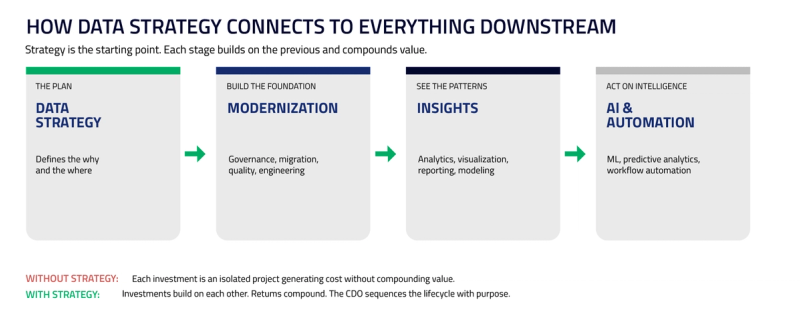
One of the most important things to understand about data strategy and something few organizations articulate clearly is that strategy is not a standalone initiative. It is the starting point for every other data investment.
At Definian, we see this through the lens of the full data lifecycle. Strategy sits upstream of everything else. It defines the "why" and the "where" so that every downstream investment has direction.
1. Strategy Feeds Modernization
A clear strategy tells the modernization team what to modernize first and why. Without it, migration projects lack prioritization, governance structures lack purpose, and data engineering efforts lack a target architecture.
2. Modernization Feeds Insights
Trusted, governed, high-quality data is the prerequisite for analytics that leadership actually believes. Without the modernization that strategy directs, analytics teams spend their time validating data rather than generating insight.
3. Insights Feed AI and Automation
Organizations that generate real value from AI and automation are the ones that invested in the data foundation first. They have governed data, clear lineage, quality thresholds, and the architectural infrastructure that AI workloads demand.
Without strategy, each of these becomes an isolated project that generates cost without compounding value. With strategy, they build on each other and the returns compound over time. A CDO who gets strategy right can sequence the entire data lifecycle with purpose. A CDO who skips strategy is managing a portfolio of disconnected projects.
When to Bring in a Data Strategy Partner
Not every organization needs external help to build a data strategy. Here are clear signals that suggest that the complexity exceeds what internal teams can handle alone:
1. Post-Merger Complexity
Two or more entities with different systems, different definitions, and different data cultures need to be unified. This is one of the highest-risk moments in a data lifecycle. It requires methodology that has been tested at scale.
2. Multiple Failed Initiatives
If the organization has already attempted one or two data strategy or AI projects that stalled or failed to deliver, the problem is usually structural. An external perspective can diagnose what went wrong and design an approach that avoids repeating mistakes.
3. No Internal CDO
Organizations without a CDO or equivalent leader often lack the internal authority and methodology to drive a strategy across business units. A partner can provide the framework, facilitate the stakeholder conversations, and deliver the roadmap, while the organization builds its own data leadership capability.
4. Board-Level AI Pressure Without Data Readiness
When the executive team wants AI outcomes, but the data foundation is not ready to support them, a partner can bridge the gap defining what "AI-ready" actually requires and building the phased plan to get there.
When evaluating partners, look for full-lifecycle capability. Many firms produce strategy documents. Fewer can execute against them through modernization, analytics enablement, and AI deployment. The partner who can take strategy from blueprint to production is fundamentally more valuable than the one who hands off a document and leaves.
Frequently Asked Questions About Data Strategy
What is a data strategy?
A data strategy is a comprehensive plan that defines how an organization collects, manages, governs, and uses data to achieve its business objectives. It aligns people, processes, and technology around shared data priorities and provides the roadmap for turning data into a strategic asset.
Why is a data strategy important in 2026?
Three forces make it non-negotiable: AI initiatives require governed, high-quality data foundations to succeed; regulatory complexity demands awareness of what data you have and how it flows. And fragmented data investments are compounding waste across most enterprises. Organizations without a strategy are deploying AI on broken foundations and accumulating governance debt that grows more expensive to resolve over time.
What are the key components of a data strategy?
A complete data strategy addresses six interconnected areas:
- Vision and business alignment
- Data architecture and infrastructure
- Governance and quality standards
- Analytics and AI readiness
- Operating model (centralized, decentralized, or federated)
- Prioritized execution roadmap
How long does it take to build a data strategy?
A focused strategy engagement typically takes 8 to 12 weeks for the assessment and roadmap, with execution phased over 12 to 24 months, depending on organizational complexity and the breadth of modernization required.
Who owns data strategy in an organization?
Typically, that should be the CDO or an equivalent senior leader who has the authority to drive cross-functional alignment and the accountability for outcomes. Without executive sponsorship, strategies become shelfware well-intentioned documents that never translate into operational change.
How can an organization ensure its data quality for an effective strategy?
Data quality starts with governance, not tooling. Assign domain ownership. Define what "acceptable" means in business terms, not just technical ones. Build validation into the pipelines your most important decisions depend on. Organizations that sustain data quality long-term didn't find a better platform. They made it someone's job to own and defend.
What are the primary challenges in implementing a data strategy? How can they be overcome?
Most data strategies fail for structural reasons. Governance disconnects from budget authority. The CDO owns the vision while the CIO controls the infrastructure. The roadmap lists initiatives with no named owner. These are accountability gaps. Fix them by putting a sponsor and a deadline on every item in the strategy before it goes anywhere near an executive.
What role does AI and machine learning play in modern data strategies?
AI and ML are why data strategy matters more in 2026 than it did five years ago. The models are not the hard part. The data they depend on is. Most organizations push AI into production on data that was never structured or governed for ML workloads. AI readiness needs to be a design requirement from day one. Sequence which data domains need governance or quality improvements before any model touches them. The 60% AI project abandonment rate Gartner projects through 2026 is a data problem. Call it what it is.
If your CEO asked tomorrow, "What is our data strategy?" would you have a clear, confident answer?
If not, that is the answer.
The organizations that act on this now will build the foundations that compound over the next two to five years in AI readiness, governance maturity, and decision-making speed. Organizations that defer will spend those years managing the consequences of fragmented investments and accumulated data debt.
Start the conversation with Definian. Not a sales pitch, an honest assessment of whether this is the right problem to solve right now.