


The ability to leverage data effectively can be the deciding factor between business success and obsolescence. Organizations that excel in harnessing data are often referred to as "data leaders," while those that struggle with data utilization are labeled "data laggards." Understanding the distinctions between these two categories can provide valuable insights for businesses aiming to ascend the data maturity curve.
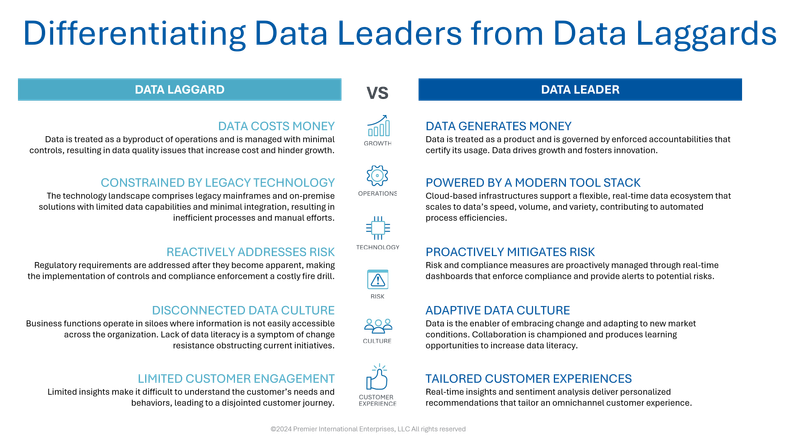
1. Data Culture: Disconnected vs. Adaptive:
Data Laggards often operate with a disconnected data culture. In these organizations, business functions are siloed, making information difficult to access across departments. This fragmentation is exacerbated by a lack of data literacy and resistance to change, which obstructs current initiatives and hampers overall efficiency.
Data Leaders, in contrast, foster an adaptive data culture. Here, data is viewed as a catalyst for embracing change and adapting to new market conditions. Collaboration is encouraged, creating learning opportunities that enhance data literacy across the organization. This culture of adaptability ensures that data is not just collected but also understood and utilized effectively.
2.Technology Infrastructure: Legacy Systems vs. Modern Data Stack
Data Laggards are often constrained by legacy technology. These organizations rely on outdated mainframes and on-premise solutions that offer limited data capabilities and minimal integration. This reliance on legacy systems results in inefficient processes and a high degree of manual effort, stifling innovation and responsiveness.
Data Leaders leverage a modern data stack. They utilize cloud-based infrastructures that support flexible, real-time data ecosystems. These systems can scale to accommodate the speed, volume, and variety of data, enabling automated processes and improving overall efficiency. This modern approach not only streamlines operations but also provides a robust foundation for future growth.
3. Risk Management: Reactive vs. Proactive
Data Laggards tend to address risk in a reactive manner. Regulatory requirements are often met only after issues arise, resulting in costly and inefficient compliance efforts. This reactive stance leaves organizations vulnerable to unforeseen risks and regulatory challenges.
Data Leaders adopt a proactive approach to risk management. They utilize real-time dashboards to enforce compliance and provide alerts to potential risks before they become critical issues. This proactive stance not only minimizes risk but also ensures that compliance measures are integrated seamlessly into daily operations, reducing costs and enhancing security.
4. Customer Engagement: Limited vs. Tailored
Data Laggards suffer from limited customer engagement. Due to insufficient insights, these organizations struggle to understand customer needs and behaviors, leading to a fragmented and disjointed customer journey. This lack of engagement can result in lower customer satisfaction and loyalty.
Data Leaders excel in creating tailored customer experiences. They use real-time insights and sentiment analysis to deliver personalized recommendations, crafting an omnichannel experience that resonates with individual customers. This tailored approach enhances customer satisfaction, loyalty, and overall business growth.
5. Data Value: Costly Byproduct vs. Growth Driver
For Data Laggards, data is often seen as a costly byproduct of operations. Managed with minimal controls, data quality issues abound, leading to increased costs and hindered growth. This perspective prevents organizations from recognizing the full potential of their data assets.
Data Leaders treat data as a valuable product. They enforce robust governance and accountability measures to ensure data quality and certify its usage. By managing data as a critical asset, these organizations drive growth and foster innovation, turning data into a powerful engine for business success.
The journey from being a data laggard to becoming a data leader requires a fundamental shift in culture, technology, risk management, customer engagement, and data valuation. Organizations that embrace these changes can unlock the full potential of their data, transforming it from a byproduct into a strategic asset that drives growth, innovation, and competitive advantage. By understanding and implementing the strategies of data leaders, businesses can position themselves at the forefront of the digital economy, ready to navigate the complexities of the modern market with agility and confidence.
Contact Definian today to engage with one of our data experts who can help you start applying data-first strategies to make the most of your information, gain a competitive edge by analyzing insights that inform decisions, and create value for your organization.